|
Robotic tele-echography (TER) |
|
|
The clinical objective is to enable en expert operator to remotely
perform echographic examinations. The system type
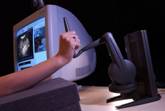
is master-slave. Thanks to the master workstation (top) allowing for real-time
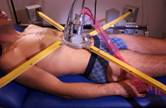
image display and force feedback to the operator, he (she) can control the echographic probe movements. The slave system (bottom) is
a light, cable-driven robot with 2 degrees of freedom (dof)
for translation on the patient body and 4 dofs for
rotation of the probe (3dofs) and one fine translation for pressure control
on the body. A visio conference makes it possible
for the two sites to dialog. The system has been demonstrated with several
types of telecommunications networks. The CAMI team has set-up and managed
the overall project and has designed and developed the slave robot. This
project has been clinically evaluated in a first stage for patients suffering
from abdominal aneurysms (between the angiology and
radiology departments of |
|
|
References : A. Vilchis, J. Troccaz,
P. Cinquin, K. Masuda, F. Pellissier. A new robot architecture for tele-echography. IEEE
Trans. On Robotics and Automation, Special
issue on Medical Robotics, Vol19, No5, pp922-926, october 2003 (PDF) T.
Martinelli, J.L. Bosson, L. Bressollette,
F. Pelissier, E. Boidard,
J. Troccaz, P. Cinquin. Robot-based tele-echography; clinical
evaluation of the TER system in abdominal aortic exploration. Journal of
Ultrasound in Medicine, 2007 ; 26 :1611-1616 |
|
|
Collaborations :
France Telecom R&D, Praxim, Grenoble hospital,
CIC, Brest hospital, LATIM |
|
|
Status: SLEEPING several patents – two clinical evaluations completed |
|
|
More information :
Best PhD thesis Award, INPG, 2003 Adriana Vilchis-Gonzales
|
|
|
Contact : jocelyne.troccaz@imag.fr or philippe.cinquin@imag.fr |
|