|
Robotic prostate brachytherapy |
|
|
Prostate
brachytherapy, used for cancer treatment, consists in inserting radioactive
seeds through needles into the gland in order to destroy cancerous cells.
This procedure is generally performed under control of transrectal
intra-operative ultrasound. The project aims at automating the needle
insertion. This task may be long and tedious for the clinician and manual
insertion makes plan correction due to prostate motion difficult. We have
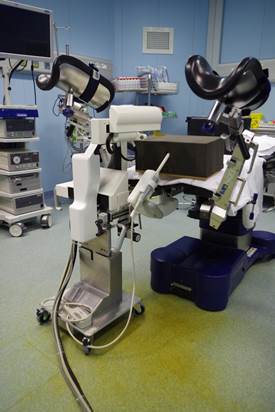
designed a robot enabling the placement and insertion of needles in the
prostate as planned. The robot can be positioned on the stepper maintaining
the ultrasound probe*. The robot combines two independent modules
respectively have 5 and 2 degrees of freedom and enabling separately the
needle pre-positioning and the needle insertion. The robot is controlled from
information coming intra-operative 3D ultrasound data. A
second version usable in the OR and a clinical protocol have been set-up for
feasibility validation on a small set of patients. * On
the top photograph: the robot (V1), its
control rack and the 3D ultrasound probe ; on bottom photograph,
first testing of the robot (V2) set-up in the OR. One can
see first experiments of the image-guided robot on a deformable phantom on
this video. |
|
|
References : Veron B, Hungr
N, Troccaz J. Making a clinical device from a laboratory prototype: from
Prosper to ProsperOR 6th Joint Workshop on New Technologies for
Computer/Robot Assisted Surgery, September 12-14, 2016 in Pisa Hungr N. Design
and evaluation of robotic systems for medical image guided needle
interventions. PhD thesis, January 2014, Université
de Grenoble (PDF).
Hungr N,
Baumann M, Long JA, Troccaz J. A 3D Ultrasound Robotic Prostate Brachytherapy
System with Prostate Motion Tracking. IEEE
Transactions on Robotics, 2012, 28(6) : 1382-1397 (PDF) |
|
|
Collaborations: Grenoble
University Hospital (Pr Bolla,
Radiation oncology dept and Pr
Descotes, Urology dept) –
Koelis company |
|
|
Funding: ANR Tecsan 2007 Project “Prosper” (Prostate Perineal Access)
– ANR Equipex ROBOTEX (“medical robotics” network)
– ANR Labex CAMI. |
|
|
Status: STOPPED Two
defended PhD theses (JA Long in 2012 and N Hungr in
2014) – Prototype evaluated on phantoms and feasibility on a specimen. The
prototype could not obtain the Electro-Mechanical Compatibility agreement
necessary for preclinical evaluation in the operating room. Modifications would have required heavy
investment and we decided to stop the project unfortunately. This is a risk
faced by translational research! |
|