|
Real time data fusion for bone tracking in CAOS |
|
|
In the context of Computer-Assisted Orthopaedic Surgery, bones are
generally tracked by means of an implanted rigid body localized for instance by
an optical sensor. We have proposed to replace this invasive method by a 3D
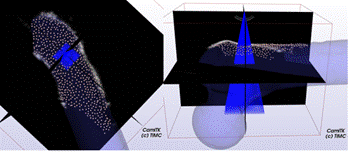
ultrasound-based tracking of the bone. One difficulty of the approach lies in
the specificity of ultrasound images of the bone (cf. figure). After a first
approach developed during the PhD of J.Schers, we
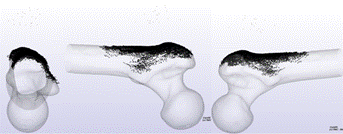
started a new project. In a first time, a robust registration method to map
CT planning to the US intra-operative conditions has been
developed in the context of hip surgery. This method is a variant of ICP which
proposes, among other features, the automatic and robust initialization of
the searched transform. It has been tested for US/CT and US/US
registration on sawbones and accuracy and robustness are very
encouraging. We also proposed specific
clinically relevant metrics for accuracy evaluation |
|
|
References: Haddad, O., Leboucher, J.,
Troccaz, J., & Stindel, E. (2016, December).
Initialized Iterative Closest Point for bone recognition in ultrasound
volumes. In Pattern Recognition (ICPR), 2016 23rd International Conference
on (pp. 2801-2806). (PDF) O.Haddad, J.Leboucher, J.Troccaz, E.Stindel. Robust rigid registration for non invasive Computer Assisted
Orthopedic Surgery (CAOS). Preliminary results. Proceedings of IEEE
ISBI’2015, New-York, April 2015 (PDF) |
|
|
Collaborations: LATIM
laboratory in Brest since 2013. |
|
|
Status: ACTIVE Two PhD thesis defended. The first one (J.Schers, 2009) in collaboration with Praxim
is associated to a patent. After a standby phase, this project started again
in the fall 2013 with a new thesis (prepared by Oussama
HADDAD) launched in collaboration with Pr Eric Stindel (LATIM, orthopedic
surgeon, Brest). |
|
|
Contact: Jocelyne.troccaz@univ-grenoble-alpes.fr
or Eric.Stindel@univ-brest.fr
|
|